
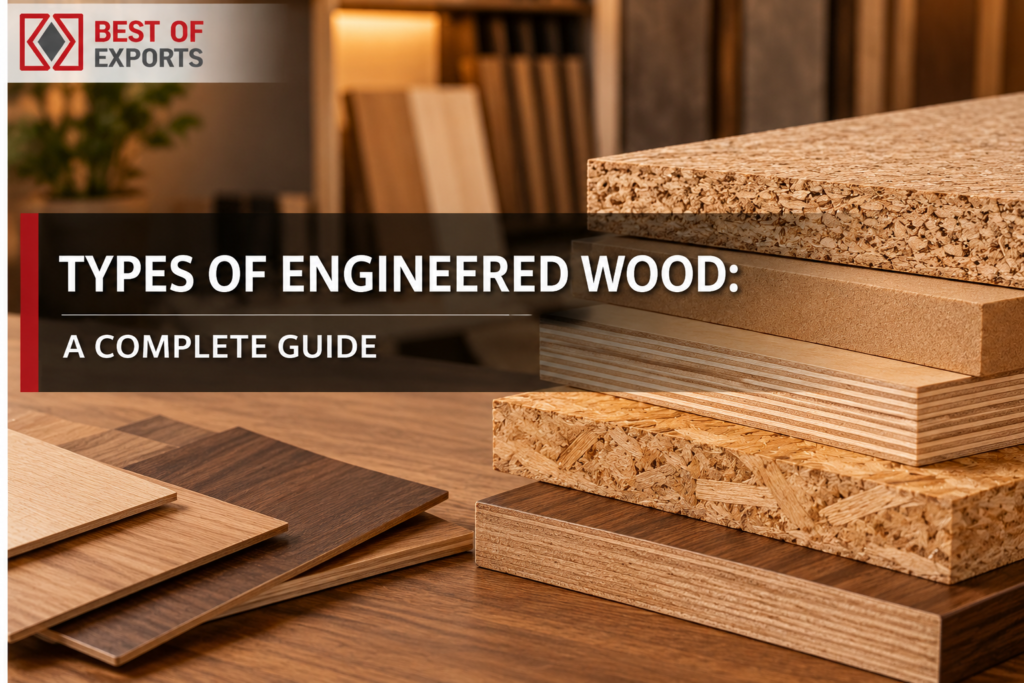
Wood has been a popular choice of people for making furniture, flooring, interiors and construction. Its natural look, strength and versatility makes it a suitable option for a wide range of uses. However, solid wood is not always the most practical option because it can be expensive, may expand or contract with changes in temperature and humidity and large pieces of solid good quality wood can be difficult to source.
There are many types of engineered wood. Some are best for furniture and decorative work while others are used in structural construction. Understanding their differences can help you select the right material for your project.
What Is Engineered Wood?
Engineered wood is a type of wood which is a product made by joining natural wood materials together. Manufacturers may use thin sheets of wood, wood fibres, chips, strands or small pieces of timber to make it. These materials are mixed or joined with glue and then pressed using heat and pressure. This creates boards and larger wood pieces that have a more even shape and size.
Solid wood comes directly from a tree so it naturally has knots, different grain patterns and other small differences. Engineered wood is produced in factories which allows the manufacturers to create boards that have a more even look and size.
However, all engineered wood products are not the same. A board made for furniture may not be strong enough for construction while a board made for construction may not be suitable for a smooth and painted finish.
Why Is Engineered Wood Popular for Furniture?
Engineered wood has become popular because it offers many of the benefits of wood which makes it easier to create large and even boards.
The manufacturing process also allows smaller pieces of wood, fibres and other wood materials to be used instead of depending only on large pieces of timber. This can make better use of available wood.
Different products can also be made for different needs. Some are suitable for furniture, some work well for flooring and others are made for buildings and other construction work. However, the quality and strength of engineered wood can be different from one product to another. Its thickness, type, quality and use should always be checked before buying.
Also Read: Mango Wood vs Teak Wood: Which is Best for Furniture
Types of Engineered Wood
1. Plywood
Plywood is usually the most commonly used engineered wood. It is made by sticking many thin layers of natural wood together. The grain of each layer usually runs in a different direction which helps make the board stronger and more stable.
Plywood is available in many types, thicknesses and qualities. Some plywoods are made for indoor use and others are designed to handle more moisture.
Plywood is commonly used for furniture, cabinets, doors, wall panels, flooring and construction work. Good quality plywood can be strong and long lasting which is why it is a popular choice for homes and building projects.
2. Medium Density Fibreboard (MDF)
MDF is made by breaking down the wood into very small fibres. These fibres are then mixed with glue and pressed together to make a solid board.
One of the biggest benefits of MDF is its smooth surface. It does not have any knots or a rough natural grain so it is easy to paint and cut on an MDF board. This makes it a popular choice for furniture and decorative work.
It is also useful when furniture has detailed designs or patterns. Standard MDF does not handle water very well which is why it can swell if it gets wet for a long time. Moisture resistant MDF is available for areas where there may be more humidity but it should still be protected from direct water and moisture exposure.
3. Particle Board
Particle board is made using small pieces of wood, chips and sawdust that are mixed with glue and pressed into flat boards. It is usually one of the more affordable engineered wood options.
It is used for budget furniture, office furniture, shelves and ready-to-assemble furniture. These boards usually come with a laminated coating, melamine or a thin decorative layer to give it a better look.
Particle board works well for many dry indoor uses. However, this board also does not handle water very well. If it stays wet for a long time, it can swell and become damaged.
The quality of particle board also matters. Better quality particle boards are usually stronger and hold screws better than cheaper and low density boards.
4. Oriented Strand Board (OSB)
Oriented Strand Board or OSB board is made from long and thin pieces of wood. These pieces are placed in different directions and then stuck together using glue and pressure. The way the wood pieces are arranged makes OSB strong enough for many construction jobs. It is often used for walls, roofs, floors and other parts of buildings.
OSB is not usually chosen for furniture where appearance is important. Instead, it is mainly used when a strong and affordable building material is needed. Different types of OSB boards are made for different conditions. Which is why it is important to choose a board that is suitable for the type of construction work you want to do.
5. High Density Fibreboard (HDF)
HDF is similar to MDF but it is made more tightly which makes it harder and denser. It is often used for works like flooring, doors, furniture parts and decorative panels. HDF is especially common in laminate flooring where it is used as the main layer underneath the visible surface.
The main difference between MDF and HDF is their density. MDF is popular because it has a smooth surface and it is easy to cut and shape. HDF is harder. It is chosen when a stronger and denser board is needed for wood work.
6. Laminated Veneer Lumber (LVL)
Laminated Veneer Lumber or LVL is mainly used for construction. It is made by joining thin layers of wood together with the grains of the joint layers running in the same direction.
This makes the LVL boards strong along its length. It can also be made into long and straight pieces which is useful for building work. LVL is commonly used for beams, joists, columns, headers and other parts of a building that need to carry significant weight.
7. Glulam
Glulam is short for glued laminated timber. It is made by joining many pieces of wood together with strong glue to create a larger piece. It can be made in straight or curved shapes which gives builders and designers more freedom during planning a building.
Glulam is used for beams, columns, roofs, bridges and large buildings. It can also look attractive when the wood is left visible so it can provide both strength and a natural look. Another benefit of glulam is that smaller pieces of timber can be joined together to create larger pieces that would be harder to make from one solid piece of wood.
8. Cross Laminated Timber (CLT)
Cross laminated timber is made by placing many layers of wooden boards on top of each other with each layer running in a different direction. The layers are then glued together. This creates large and strong panels that can be used to build walls, floors and roofs.
CLT is becoming more popular in modern construction because large parts of a building can be made in a factory and then put together at the building site. Among the types of engineered wood used in construction, CLT is one of the products that can be used to make large parts of a building rather than just individual furniture pieces.
9. Finger Jointed Wood
Finger jointed wood is made by joining small pieces of wood together using special interlocking joints and glue. The joints look a little like fingers which is where the name comes from. This method allows the smaller pieces of wood to be joined together to make longer pieces. It also helps reduce wood waste.
Finger jointed wood is used for door parts, furniture pieces, frames, mouldings and other indoor woodwork. The quality and the strength of the joints is important so it is always better to choose a product from a reliable manufacturer and use it for the purpose it is designed for.
Also Read: Different Types of Wood for Furniture Explained
Engineered Wood vs Solid Wood
engineered wood and solid wood both have their own advantages. Solid wood is popular because of its natural grain, elegant look and lasting performance. It can also be sanded and refinished many times which depends on the type of wood.
Engineered wood is produced in a more controlled way so its size and shape are usually more consistent. It is also available in large boards and can be made for specific uses.
How to Choose the Right Engineered Wood for Your Project
The right material depends mainly on where and how you plan to use it. You may want a board that is easy to cut, paint or cover with laminate For making furniture. Strength and the ability to hold screws are also important. Hardness and resistance to everyday use matter more for flooring purposes.
Moisture is another important factor. If the material will be used in a kitchen, bathroom or another humid area then you should choose a board that is suitable for these conditions.
For construction work, always use a product made for the specific job. A material designed for furniture should not be used for a part of a building that needs to carry a heavy load.
It is also worth checking the manufacturer’s instructions before buying. The right thickness and quality can make a big difference to the performance and life of the type of the engineered wood.
Advantages and Limitations of Engineered Wood
Engineered wood is popular because it can be made in different forms for different uses. It also makes good use of smaller pieces of wood and can offer boards with an even size and shape.
Some common advantages of engineered boards are:
- Even size and shape
- Efficient use of wood
- Available in many thicknesses and sizes
- Suitable for furniture and construction
- Easy to cover with paint, laminate or veneer
- Different products available for different needs
However, engineered wood also has some drawbacks. Some products do not handle water well and cheaper boards may not be strong enough for heavy use. Many engineered wood products also contain glue and resins so it is useful to check the product information before buying.
Which Engineered Wood Is Best for Furniture?
There is no single best option for every piece of furniture. Plywood is usually chosen when strength and durability are important. MDF is a popular choice for painted furniture because it has a smooth surface and is easy to shape. Particle board is used for more affordable furniture especially when it is covered with laminate.
The place where the furniture will be used also matters. A wardrobe in a bedroom will generally face different conditions from a kitchen cabinet which may be exposed to moisture, heat and frequent cleaning. The quality of the furniture also depends on how the pieces are joined, the hardware used and the quality of the final finish.
Also Read: How to Identify Acacia Wood: A Complete Beginner’s Guide
Is Engineered Wood Durable?
Yes, many engineered wood products can last for years when the right product is used correctly. How long it lasts depends on the type of board, its quality, thickness, exposure to moisture and how well it is installed and maintained.
Taking care of the furniture can also help it last longer. Keeping it away from unnecessary moisture and following the manufacturer’s care instructions can help prevent common problems like warping and dampness.
Conclusion
The many types of engineered wood available in the market today make wood based materials useful for a wide range of furniture, interior and construction projects. Plywood, MDF, particle board, OSB, HDF, LVL, glulam and CLT all have their different features and uses.
The best option depends on what you need the material to do. Think about factors like strength, look, moisture, durability and cost before making your choice.
Instead of choosing engineered wood simply because it is cheaper or more popular, look at the specific requirements of your project. Getting the right product and using it correctly can give you a strong, practical and long lasting result.

Pingback: Is Engineered Wood Good for Beds? Find Out Here