
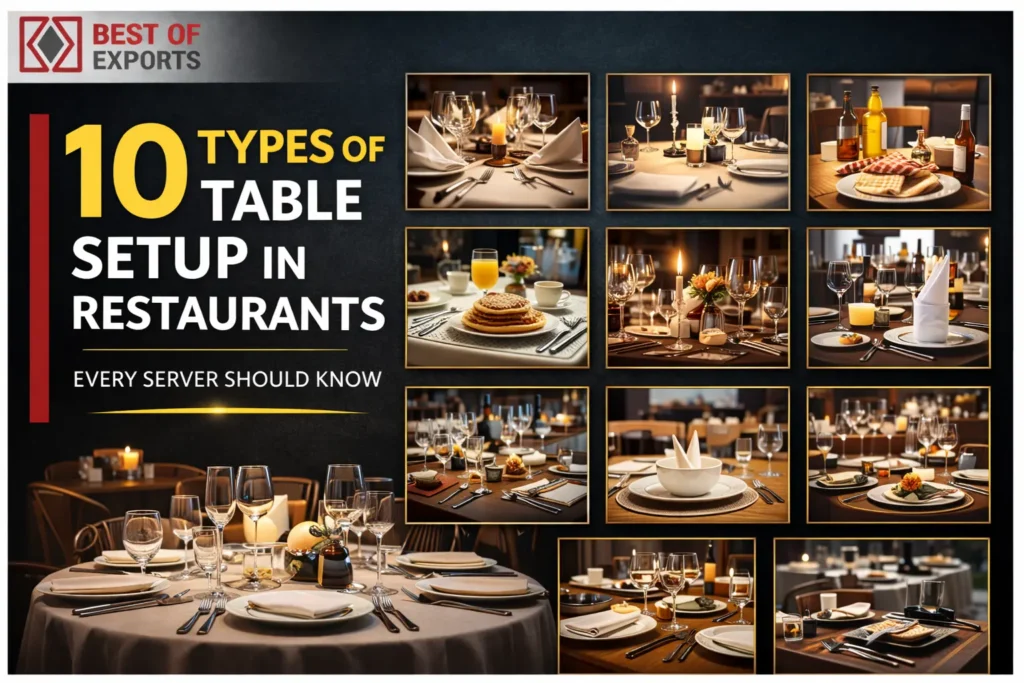
A nicely arranged table is the first thing guests notice when they enter a restaurant. It shows how much care goes into the service. Table setup is not just about placing plates and cutlery. Learning the different types of table setup in restaurants service is an important basic skill for servers. It shows professionalism and makes sure guests have everything they need. Each setup has a clear purpose, right from a small café to a fine dining restaurant.
This comprehensive and detailed guide explains ten important types of table setup in restaurants spaces that every server should understand. Learning these styles helps servers work faster and improves guest satisfaction. We will explain everything from simple to very formal setups. You will learn where each item is placed and why. This knowledge is very important for anyone who wants to do well in the hospitality industry because the small details in table setup make a big difference.
Understanding the Basics of Table Setting
It is important to know some basic rules that apply to almost all setups and help create a neat and professional look before learning the different types of table setup in restaurants service.
- Forks: If there is more than one fork, they are placed in the order they will be used from the outside moving in.
- Knives: Knives are placed on the right side of the plate with the sharp edge facing the plate.
- Spoons: Spoons are placed to the right of the knives and are also arranged from the outside in based on usage.
- Plates: The main plate or charger plate sits in the centre and forms the base of the setting.
- Glassware: Glasses are placed at the top right area above the knives and spoons.
- Napkin: Napkins can be placed on the plate, to the left of the forks, or sometimes inside the water glass.
Now let us look at the ten main types of table setup in restaurants dining.
1. Basic Table Setting
The basic table setting is the simplest and most common style. It is mainly used in casual restaurants, cafés and everyday dining. It works well for a single course meal.
How to set it up:
- Plate: A dinner plate is placed in the centre of the setting.
- Fork: A single dinner fork is placed to the left of the plate.
- Knife: A dinner knife is placed to the right of the plate, blade facing the plate.
- Spoon: If needed, a spoon is placed to the right of the knife.
- Water Glass: A water glass goes above the knife.
This setup is very easy to learn and is widely used in fast service environments. It is one of the most common types of table setup in restaurants spaces.
Also Read: How to Start Restaurant Business in India – A Step-By-Step Guide
2. Informal Table Setting
The informal table setting is a little more advanced than the basic setup. It is suitable for meals that include more than one course such as soup, a main dish and dessert. It is often seen in full-service restaurants.
How to set it up:
- Plates: A dinner plate is in the centre. If soup is served first, the soup bowl is placed on top of the dinner plate.
- Forks: Two forks are used. The dinner fork is placed closer to the plate on the left and the salad fork (or starter fork) is on its left.
- Knife and Spoons: The dinner knife is to the right of the plate. If soup is served, the soup spoon goes to the right of the knife.
- Bread Plate: A small bread plate is placed at the top left of the setting, above the forks with a butter knife laid across it.
- Dessert Utensils: The dessert spoon and fork are placed horizontally above the dinner plate.
This style is one of the most balanced types of table setup in restaurants service because it looks neat and works well in many situations.
3. Formal Table Setting
The formal table setting is the most detailed and elegant style. It is mainly used in fine dining restaurants, weddings and formal events. It supports multiple courses served in a specific order.
How to set it up:
- Charger Plate: A charger is placed in the centre which is a large decorative plate. The dinner plate and subsequent course plates are placed on top of it.
- Forks: Multiple forks are arranged to the left of the charger, from outside in this order: salad fork, fish fork and dinner fork.
- Knives and Spoons: To the right of the charger, from outside in: soup spoon, fish knife and dinner knife.
- Glassware: A collection of glasses is at the top right: water goblet, red wine glass and white wine glass.
- Bread Plate: The bread plate and butter knife are at the top left.
- Dessert Utensils: A dessert spoon and cake fork are placed horizontally above the charger.
- Napkin: A cloth napkin is often ornately folded and placed on the charger plate.
This is one of the most detailed types of table setup in restaurants environments and shows luxury and high standards.
4. Buffet Table Setting
The buffet setup is different because guests serve themselves from a food station. The table setting is simple and practical.
How to set it up:
- Cutlery Roll-up: The cutlery (fork, knife and spoon) is typically rolled up in a napkin and placed in the centre of the guest’s space.
- Plates: Plates are stacked at the beginning of the buffet line and not at the table.
- Glassware: A water glass is usually the only glass pre-set on the table. Other drinks are collected by the guest or served by staff.
- Condiments: Salt, pepper and other common condiments are often placed in the centre of the table for sharing.
This is a practical example of types of table setup in restaurants events that serve many people at once.
5. Casual or Family-Style Table Setting
This style is used when food is shared and placed in the centre of the table. Guests serve themselves from common dishes.
How to set it up:
- Dinner Plate: A dinner plate is placed at each seat.
- Cutlery: A basic setup of a fork to the left and a knife to the right is sufficient. Serving spoons and forks are placed with the shared platters.
- Napkin: A simple napkin is placed on the plate or next to the fork.
- Glassware: A water glass is set for each guest.
- Space: The key is to leave ample space in the centre of the table for the large serving dishes.
This relaxed style encourages conversation and is a popular example of types of table setup in restaurants dining.
Also Read: Top 10 Restaurant Trends to Watch in 2026
6. French Style Table Setting
The French table setting is known for its elegance and classic arrangement. It shares similarities with the formal setting but has some distinct features. It often includes more cutlery as French cuisine can be elaborate.
How to set it up:
- Arrangement: Cutlery is arranged similarly to the formal setting with forks on the left and knives or spoons on the right. A unique feature is that forks are often placed with the tines facing down.
- Glassware: Multiple wine glasses are common and reflect the importance of wine pairing in French dining.
- Cheese Course: A separate knife for the cheese course might be included.
- Symmetry: Perfect symmetry and alignment are paramount.
This is a sophisticated entry among the different types of table setup in restaurants styles, perfect for French bistros and fine dining.
7. Russian Style Table Setting
In Russian service, food is carved and plated in the kitchen before being brought to the guest. The table setting is arranged to accommodate this formal service style. It is elegant and often seen in very high-end restaurants.
How to set it up:
- Charger Plate: A charger plate remains throughout the meal until dessert.
- Cutlery: The number of utensils is minimal at the start. Cutlery for each course is brought to the table with the corresponding dish. This “à la russe” service style means the cover is less cluttered initially.
- Service: The server places the plated food in front of the guest from the right side.
This is a highly formal style and a distinct member of the types of table setup in the restaurants family which focuses on seamless service.
8. English Style Table Setting
English style service or “family style,” involves the host carving the main meat at the table and serving the guests. The table setting must facilitate this personal touch.
How to set it up:
- Host’s Place: The host’s place at the head of the table has extra space for the large platter of meat and serving utensils.
- Guest Settings: Each guest has a dinner plate, fork and knife. Other utensils might be added depending on the side dishes.
- Serving: The host serves the meat and side dishes are passed around the table for guests to serve themselves.
This traditional approach is more common in homes but can be found in some classic restaurants. It is one of the more interactive types of table setup in restaurants experiences.
9. American Style Table Setting
American style service is the most common in the United States and many parts of the world. The table setting is practical and efficient.
How to set it up:
- Basic to Informal: The setup usually ranges between a basic and an informal setting which depends on the restaurant’s calibre.
- Placement: Forks are on the left, knife and spoon on the right. The salad fork is placed before the salad course is served.
- Efficiency: The setup is designed for quick service with all necessary items readily available.
Understanding this is fundamental as it is one of the most widespread types of table setup in restaurants formats globally.
10. Asian Style Table Setting
Asian table settings vary greatly by country, for example, Chinese, Japanese or Korean. But they share common elements that differ significantly from Western styles. The focus is on communal eating and specific utensils.
How to set it up:
- Chopsticks: A pair of chopsticks is the primary utensil, placed on a chopstick rest to the right of the bowl.
- Spoon: A deep, ceramic spoon is used for soup and is placed on the chopstick rest or in the bowl.
- Bowls: Instead of a flat plate, a small rice bowl is the main vessel. Smaller bowls for sauces and side dishes are also common.
- Tea Cup: A small teacup without a handle is typically included.
This setup is important for servers in Asian restaurants to understand. This is a culturally specific approach among the types of table setup in restaurants service. Knowing these varied types of table setup in restaurants layouts is a key skill for any server.
Also Read: How Many Licenses Required for Restaurant Business? Beginner’s Guide
Conclusion – Types of Table Setup in Restaurants
Learning the different types of table setup in restaurants service is a must for every professional server. It shows the level of service, the food style and how much the restaurant cares about details. When you understand where every fork, knife, glass and plate belongs, you can work with more confidence, serve faster and make guests feel comfortable and happy. These ten types of table setup in restaurants environments form the base of excellent table service.
If you want to improve your restaurant service standards and build a team that impresses every guest, now is the right time to act. Contact us today to learn more about our complete hospitality training programmes. We can help you turn every table into a perfectly prepared space for a memorable dining experience. Our strong knowledge of all types of table setup in restaurants operations will help your team perform better and stand out.
Frequently Asked Questions about Types of Table Setup in Restaurants
1. Why is knowing different types of table setup in restaurant service important for a server?
It is important because it shows professionalism and readiness for any situation. It helps guests get the right cutlery for every course without confusion. It also helps servers work faster and more smoothly in both casual and fine dining restaurants which improves guest satisfaction.
2. What is the main difference between an informal and a formal table setting?
The main difference lies in the number of courses they accommodate and the level of detail. An informal setting is typically for a three-course meal and includes basic cutlery, a water glass and perhaps one wine glass. A formal setting is for a multi-course meal (often six or more courses) and includes multiple forks, knives, spoons, several glasses, a bread plate and a charger plate. The formal setup is more symmetrical and elaborate, reflecting a higher standard of dining.
3. What is a charger plate and when is it used?
A charger plate is a large decorative plate used in formal dining. It stays on the table under other plates like soup or salad plates. People do not eat directly from it. It is usually removed before the main course and is used only to make the table look elegant.
4. How should cutlery be arranged on the table?
Forks go on the left of the plate (salad fork outside, dinner fork inside). Knives and spoons go on the right (soup spoon outside, dinner knife inside, blade facing the plate). Dessert utensils are placed horizontally above the plate.
5. In which direction should the knife blade face on a table setting?
This is a rule of etiquette and safety. Placing the blade inward is less aggressive and reduces the risk of someone accidentally cutting themselves when reaching for a glass or another item on the table.
6. Where are glasses placed in a table setting?
Glassware is always placed at the top right of the dinner plate, above the knives and spoons. The water glass or goblet is typically the first glass, placed directly above the dinner knife. Wine glasses are then placed to the right of the water glass, often in the order they will be used (e.g., white wine glass, then red wine glass).
7. Is there a standard for folding napkins?
There is no single standard style. In casual settings, simple folds are used. In formal dining, creative and decorative folds are common. Napkins can be placed on the plate, beside the forks or sometimes inside the water glass.
8. What makes the Asian table setting unique compared to Western types of table setup in restaurant service?
Asian table settings are different because they use chopsticks and deep soup spoons instead of forks and knives. A rice bowl is used instead of a flat plate. Food is often shared and placed in the centre of the table. Small bowls are used for sauces and side dishes. This shows a more shared and cultural way of dining compared to Western styles.

Pingback: How to Choose the Perfect Restaurant Flooring Design
Pingback: Top 11 Hotel Lock Systems for Modern Hotels in 2026